
The Sacred Thread: How to Spot Authentic Odisha Handloom in an Age of Powerloom Counterfeits
The handloom heritage of Odisha represents over a millennium of mathematical tie-dye mastery, sacred temple symbolism, and living indigenous art. Yet today, digital markets are flooded with cheap polyester powerloom imitations manufactured in industrial textile mills and falsely sold as genuine Sambalpuri weave. Here is how discerning patrons identify authentic artisanal handlooms and preserve generational weaver lineages.
🔑 Essential Principles
- The Bandhakala Mathematical Craft: Authentic Sambalpuri Ikat is not printed onto cloth; individual warp and weft yarns are tied with water-resistant rubber strips and dyed in intricate mathematical sequences before being mounted on a wooden pit loom.
- The Reverse-Side Mirror Test: Genuine hand-tied Bandha textiles display near-identical pattern clarity and color saturation on both the face and the reverse of the fabric. Machine-printed powerloom knockoffs exhibit a dull, bleached, or washed-out reverse side.
- Temple Selvedge Pinholes (Fehli): Authentic handloom sarees display tiny, subtle pinhole perforations along the border edges where wooden temple stretchers gripped the fabric during manual hand-weaving to maintain uniform tension.
- The Burn Test for Pure Fibers: Natural Mulberry/Tussar silk and organic cotton leave soft, crushable ash smelling of burnt hair or paper. Synthetic polyester fakes melt rapidly with black chemical smoke, forming a hard, unyielding plastic bead.
- Ethical Weaver Direct Compensation: Generational artisan communities in Bargarh, Sonepur, and Nuapatna spend 40 to 90 days hand-weaving a single masterpiece. Sourcing directly from certified cooperative societies ensures fair living wages and prevents the extinction of ancient cultural knowledge.
In a quiet village in Bargarh district, western Odisha, the rhythmic clack-clack of a wooden pit loom echoes through the morning mist. An artisan family sits cross-legged on the earth, their hands moving with surgical precision. Between their fingers pass hundreds of gossamer-thin cotton threads, each carrying minute mathematical dye markings applied weeks before the first shuttle was ever thrown.
Across sixty days of painstaking manual labor, those individual dyed yarns will align to form the sacred shankha (conch), chakra (wheel), padma (lotus), and traditional fish motifs of a Sambalpuri Bandha saree. No computer programmed this design. No chemical screen press stamped the canvas. It is a living, breathing tapestry born of ancestral memory, tactile geometry, and human devotion.
Now travel 1,500 kilometers west to an automated industrial textile facility in Surat.
High-speed rotary screen printing machines and computerized powerlooms roar continuously under corrugated tin roofs. Cheap 100% synthetic polyester yarns are fed into automated reels. In less than eight minutes, a machine stamps an exact photographic digital reproduction of that same Sambalpuri motif onto petroleum-derived cloth. The synthetic fabric is folded into plastic sleeves, labeled with an unauthorized “Pure Handloom” sticker, and shipped to e-commerce marketplaces to be sold for &rupee;899.
This is the silent crisis confronting India's handloom heartland. When industrial counterfeits flood the market, consumers unknowingly purchase plastic fakes that trap heat and unravel after three washes, while the master weavers whose families preserved this sacred craft for thirty generations are driven to economic ruin.
1. Understanding Bandhakala: The Discrete Mathematics of Odisha Ikat
To understand why authentic Odisha handloom cannot be replicated by an industrial powerloom, one must understand the metallurgical and mathematical complexity of Bandhakala (the traditional resist tie-and-dye technique).
In standard textile manufacturing, plain yarn is woven into fabric, which is then passed under printing cylinders or dyed in a solid vat. In Bandhakala, the process is inverted: the design is calculated and dyed into the threads before weaving even begins.
- Warp and Weft Calculation: The master artisan calculates the exact density of the warp (longitudinal threads) and weft (transverse threads). A single Sambalpuri saree requires over 4,800 individual warp threads running a length of 5.5 to 6.2 meters.
- Graphing and Tying (Bandha): Bundles of yarn are stretched across a wooden tying frame. Using natural rubber or treated thread strips, the artisan tightly binds specific sections of the yarn with microscopic accuracy. These bound areas resist dye absorption.
- Serial Dip-Dyeing: The yarn is immersed in the first dye bath (traditionally natural vegetable dyes like madder root, indigo, and pomegranate peel). The yarn is dried, untied, re-tied in different geometric configurations, and dyed again in progressive color sequences.
- Loom Mounting and Precision Alignment: The dyed warp is mounted onto a traditional wooden pit loom dug into the mud floor of the weaver's home. As the weaver presses the wooden foot pedals and shoots the wooden shuttle through the shed, each weft thread must strike its intersecting warp counterpart with millimeter precision to reveal the intended curvilinear motif.
Because the dye slightly bleeds into the boundary fibers where the ties were secured, authentic Bandha motifs display a signature, soft “feathered” edge. This gentle, organic feathering is the unmistakable hallmark of human hands manipulating tension — a physical characteristic that automated rotary printing machines cannot duplicate.
A powerloom prints a picture of a motif onto dead fabric. A handloom weaves the motif out of dyed souls of yarn. One is plastic ink; the other is living geometry.
2. The Regional Weaves of Odisha: A Sacred Cartography
Odisha is not home to a single handloom tradition, but a rich constellation of geographically distinct weaving lineages, each recognized with a prestigious Geographical Indication (GI) tag under the World Intellectual Property Organization (WIPO):
| Weave Tradition | Geographic Origin | Defining Technical Characteristics | Signature Cultural Motifs |
|---|---|---|---|
| Sambalpuri Bandha | Bargarh, Sambalpur, Sonepur | Double-ikat (warp and weft tie-dye), curvilinear borders, high-count natural cotton and mulberry silk. | Shankha (conch), Chakra, fish, flora, Pasapalli (royal chess-board checks). |
| Bomkai (Sonepuri) | Ganjam & Subarnapur | Extra-weft structural patterning using traditional jaala draw-loom mechanisms; dense mythological pallu. | Peacocks, bitter gourd (charikothi), lotus, traditional Odia temple spires. |
| Kotpad Organic | Koraput (Mirgan community) | 100% heavy unbleached tribal cotton dyed exclusively with the natural roots of the Aal (Indian Madder) tree. | Tribal totems, crabs, axes, bows, boats, deep earthy terracotta-red and chocolate hues. |
| Khandua Pata | Nuapatna & Maniabandha | Sacred temple silk woven with verses from Jayadeva's 12th-century Sanskrit epic Gita Govinda for Lord Jagannath. | Calligraphic Sanskrit verses, elephants, deula (temple towers), celestial vines. |
| Habaspuri | Kalahandi district | Geometric extra-weft longitudinal bands on unbleached coarse cotton, woven by the indigenous Kondh community. | Kumbha (temple spires), fish scales, hill contours, regional wildlife. |
3. The 5 Physical Authenticity Tests: How to Unmask Counterfeits
How can an everyday patron purchasing online or in a boutique verify whether a textile is a genuine handloom or an industrial knockoff? Memorize these five empirical, physical verification tests:
Test 1: The Reverse-Side Mirror Inspection
Turn the saree or fabric over and inspect the reverse side with bright, natural lighting. In authentic Sambalpuri Bandha and double-ikat weaves, the design is woven through the yarn itself, meaning the pattern on the back will be nearly indistinguishable in clarity, vibrance, and precision from the front.
In contrast, a cheap powerloom fake or digital screen print only deposits pigment on the top surface. The reverse side of a counterfeit will appear noticeably dull, faded, chalky, or completely white.
Test 2: The Temple Pinholes (Fehli / Peta Marks)
Run your fingertips along the extreme outer selvedge (the longitudinal finished edges) of the fabric. In an authentic pit-loom handloom, you will feel and see minute, evenly spaced pinholes every few inches.
These holes are created by the fehli — a wooden temple stretcher equipped with tiny iron needles that the weaver moves forward every few inches to keep the woven cloth taut across the pit loom. Automated powerlooms use continuous air-jet or rapier feeds and do not produce manual stretcher pinholes.
Test 3: The Edge Feathering vs. Pixelation Test
Examine the borders of complex motifs (such as a conch or lotus) through a magnifying glass or your smartphone camera's macro lens. Authentic Ikat displays natural, subtle dye bleed (feathering) where the resist threads were tied. It looks organic and painterly.
A digital print imitation will reveal rigid, sharp pixel grids or artificial dots (halftone patterns) deposited by an industrial inkjet printer head.
Test 4: The Fiber Burn Test
If you have access to a loose stray thread from the unhemmed fringe or tassel edge, perform a simple burn test using a match or lighter:
- Pure Natural Silk (Tussar / Mulberry): Burns slowly, smells distinctly of charred hair (keratin protein), self-extinguishes when the flame is removed, and leaves behind a soft, crushable dark gray ash.
- Pure Natural Cotton: Burns with a steady yellow flame, smells of burning paper or autumn leaves, and leaves light gray, feathery ash with zero melted residue.
- Synthetic Polyester / Nylon (Counterfeits): Burns rapidly with an acrid chemical plastic odor, produces black toxic smoke, and melts into a hard, black, uncrushable plastic bead that adheres to skin.
Test 5: The Tactile Breathability & Drape
Synthetic polyester fabrics are non-porous petrochemical sheets. When draped against the skin, they trap body heat, generate static electricity, and feel slick or slippery. Natural handloom cotton and hand-reeled Tussar silk possess cellular micro-pores that breathe effortlessly with ambient humidity. They feel substantial, gently textured, warm in winter, and remarkably cool in tropical summer heat.
Preserving Living Heritage: Utkal Aditri
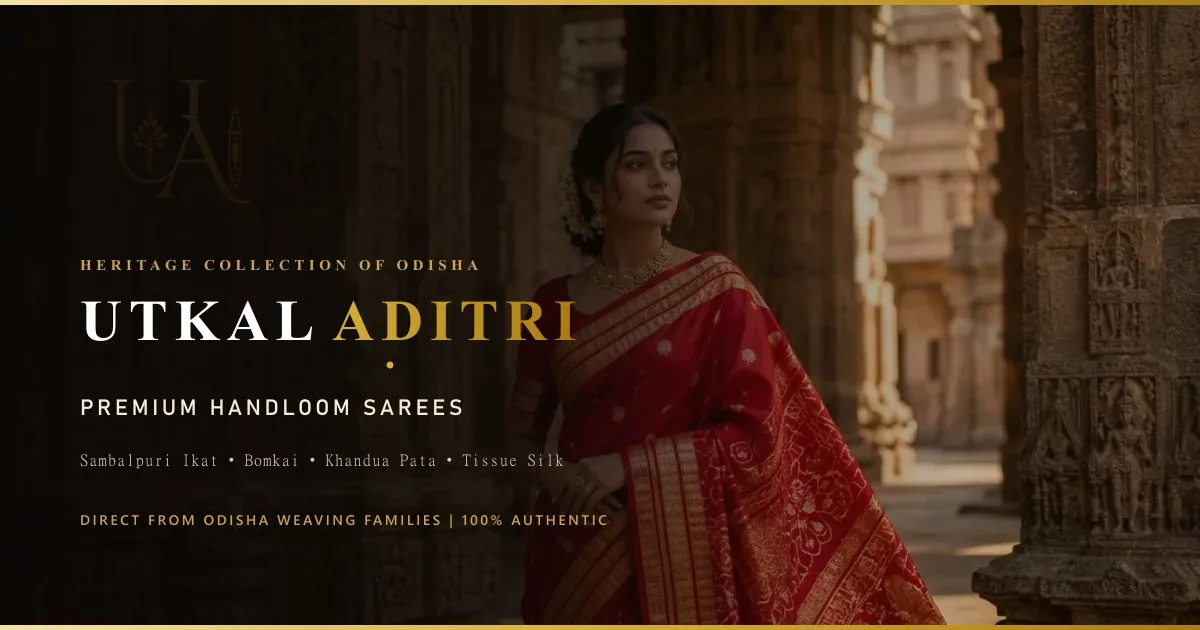
Utkal Aditri connects discerning patrons directly with certified handloom weaver cooperatives in Odisha. Every Sambalpuri Bandha, Bomkai, and Kotpad masterpiece is 100% woven on traditional wooden pit-looms using pure natural fibers, certified by Geographical Indication (GI) registries. Zero synthetic blends, zero powerloom imitations, and fair-trade compensation for generational master artisans.
4. The Economics of the Pit Loom: Why Cheap Handloom Does Not Exist
One of the most persistent misconceptions in the Indian textile market is the search for a “budget handloom saree for &rupee;1,200.” A basic understanding of artisanal economics reveals why this is mathematically impossible.
Consider the labor economics of a traditional, medium-complexity Sambalpuri cotton saree:
- Raw Material: 80-count organic cotton yarn, natural dyes, and sizing starch: &rupee;1,400 – &rupee;1,800.
- Tying and Dyeing (Bandha): 10 to 14 days of specialized artisanal labor by the master tie-dyer: &rupee;2,500 – &rupee;3,500.
- Warp Preparation & Loom Mounting: 2 days: &rupee;800.
- Weaving on Pit Loom: 12 to 18 days of continuous pedal-and-shuttle weaving: &rupee;3,500 – &rupee;5,000.
The baseline production cost of a genuine, high-grade Sambalpuri cotton handloom saree — paying the artisan family even a modest, fair living wage — cannot fall below &rupee;8,000 to &rupee;10,000. When silk is introduced, the baseline cost naturally scales to &rupee;16,000 to &rupee;35,000.
When an online retailer or tourist emporium offers a “Sambalpuri saree” for &rupee;1,499, one of two things has happened: either the garment is an industrial polyester powerloom fake manufactured in an automated mill, or an impoverished rural weaver was paid an exploitative wage of &rupee;80 per day by an unscrupulous middleman. Ethical commerce requires recognizing that true craftsmanship cannot be discounted without destroying the craftsman.
5. How to Care for Heirloom Odisha Handlooms
A genuine Odisha handloom is not disposable fast fashion; it is an heirloom textile engineered to last for generations when treated with proper care:
- First Wash Protocol: Always dry-clean silk handlooms (Tussar, Mulberry, Bomkai Pata) for their first two washings to stabilize natural yarn tensions. For pure cottons, perform a gentle cold-water soak with a tablespoon of rock salt to set the natural dyes.
- Avoid Harsh Detergents: Never use industrial enzyme detergents or chemical bleaches. Use gentle, pH-neutral soapberry (reetha) solutions or delicate liquid wool-washes.
- Never Wring or Spin Dry: Gently roll the wet textile in a clean cotton bath towel to absorb excess moisture. Dry flat in a shaded, well-ventilated area away from direct ultraviolet sunlight, which causes natural botanical dyes to fade over time.
- Storage in Breathable Muslin: Never store fine handloom sarees in sealed plastic bags, which trap ambient humidity and promote mildew or fiber embrittlement. Wrap them in unbleached white muslin cloth or pure cotton pillowcases, accompanied by dried neem leaves to naturally repel silverfish.
- Periodic Refolding: Every six months, unfold your handloom sarees and refold them along different fold lines. This prevents permanent fiber creasing and stress-fractures along the warp edges.
6. Summary: Wearing Heritage as an Act of Cultural Sovereignty
In a world increasingly dominated by mass-manufactured homogeneity, planned obsolescence, and synthetic plastic clothing, choosing an authentic handloom is an intentional act of resistance.
When you wear a genuine Sambalpuri Bandha, a Kotpad tribal weave, or a Bomkai silk, you do not simply wear a garment. You wear the sacred geometry of the pit loom. You wear the songs sung by weaver women while tying the yarn. You wear an ancient artistic sovereignty that survived centuries of colonial suppression and industrialization. By demanding authenticity and supporting fair-trade weaver cooperatives, we ensure that the sacred threads of Odisha continue to weave their magic for centuries to come.